When the Mario Movie (2023) Arrived in Theaters, Fans Pointed Straight Back to Martin Leung
"They referenced this in the Mario movie" — what viewers noticed about a Viral piano Performance video from 2004
When The Super Mario Bros. Movie arrived in 2023, Martin Leung received many messages and notifications. Viewers weren't writing about the film in general — they were writing about one specific moment. In the film's scene where Bowser and Kamek play a piano duet, the sequence of the music and sound effects matches Leung's 2004 Super Mario medley with striking precision: the same treatment of the Underworld theme, the same coin sounds, the same power-up cue, the same 1-up, followed by booming octaves.
The resemblance was noticed widely, and not only by casual viewers. A dedicated music-analysis video, “Every single musical reference from The Super Mario Bros. Movie" by Nicolas Daoust (Game Music Done Right), identifies Leung's Super Mario Medley by name while walking through the film's musical homages — playing the medley alongside the corresponding scene.
The parallel many people spotted is real, documented, and easy to hear for yourself. Whether it was intentional, Leung leaves for listeners to decide.
The Three-Way Comparison
The clearest way to understand what listeners noticed is to put three versions side by side: how the sound works in the original game, how Leung performed it in his 2004 medley, and how the 2023 film handles the same moment.
1. The Original Game
In Super Mario Bros. (1985), the mushroom power-up sound is built on a specific arpeggiated harmonic sequence: C major (second inversion), A-flat major, and B-flat major. This is the voicing coded into the game itself — the version millions of players have heard for decades.
The mushroom (power-up) sound effect from the Super Mario Bros. video game. Its arpeggiated harmonies are C major (second inversion), A-flat major, and B-flat major — the original harmonic sequence worth keeping in your ear for the comparison below.
To hear the individual harmonies more distinctly, click the "Watch on YouTube" button in the lower-right corner of the video. In the new window, select the gear icon, then move the playback-speed slider down to 0.25×.
2. Leung's 2004 Medley
When Leung played his Super Mario Medley in 2004, during the performance of the Underworld Theme, he added sound effects during the silences of the theme. One sound effect was the mushroom power-up sound effect, played by ear. His opening harmony is not the game's C major second inversion (G-C-E-G), but G major (root position, G-B-D-G) — a distinctive deviation from the original source material. It's a non-standard way of playing the mushroom sound effect, and it is the kind of detail that would be unlikely to appear in two independent recordings by coincidence.
Martin Leung, Super Mario Medley, cued to 1:43, Underworld / power-up section
3. The 2023 Movie
In the film's Bowser-and-Kamek duet, the same passage appears — and it reproduces the G major arpeggiated harmony, not the game's original C major, second inversion, arpeggiated harmony. The movie follows Leung's harmonic choice rather than Nintendo's source material.
The Super Mario Bros. Movie, Bowser & Kamek piano scene
The Super Mario Bros. Movie © Nintendo / Illumination / Universal Pictures. Comparison shown for commentary and analysis.
Why the Arpeggiated Harmonic Sequence Matters
A matching melody proves little on its own — the Mario themes are famous, and anyone recreating them would reach for the same tunes. What's harder to explain is a shared non-standard choice.
The game's mushroom sound effect has a fixed harmony. Leung, playing the mushroom sound effect by ear in 2004, played it differently. When the film arrives nineteen years later and lands on Leung's version rather than the original, the resemblance moves from “same song" to “same specific interpretation." That single harmonic fingerprint — G major where the source uses C major in second inversion — is what turns a general similarity into something far more particular.
It's one detail among several the sequence shares, but it's the one that's easiest to verify and hardest to dismiss.
Corroboration
The observation doesn't rest on Leung's account alone. In his breakdown of the film's musical references, Nicolas Daoust (Game Music Done Right) singles out Leung's recording by name and plays it against the film, treating the connection as noteworthy enough to document in detail.
“Every single musical reference from The Super Mario Bros. Movie" — Game Music Done Right (Nicolas Daoust). The video, at 2:19, identifies Leung's Super Mario medley by name and plays it against the film's Bowser-and-Kamek piano duet moment, noting the shared coin sounds, power-up cue, and 1-up.
Martin Leung — The Original Video Game Pianist™. His Super Mario medley, first performed blindfolded, has been viewed more than 45 million times.
The resemblance, in other words, was independently noticed and independently analyzed — not a claim made in isolation.
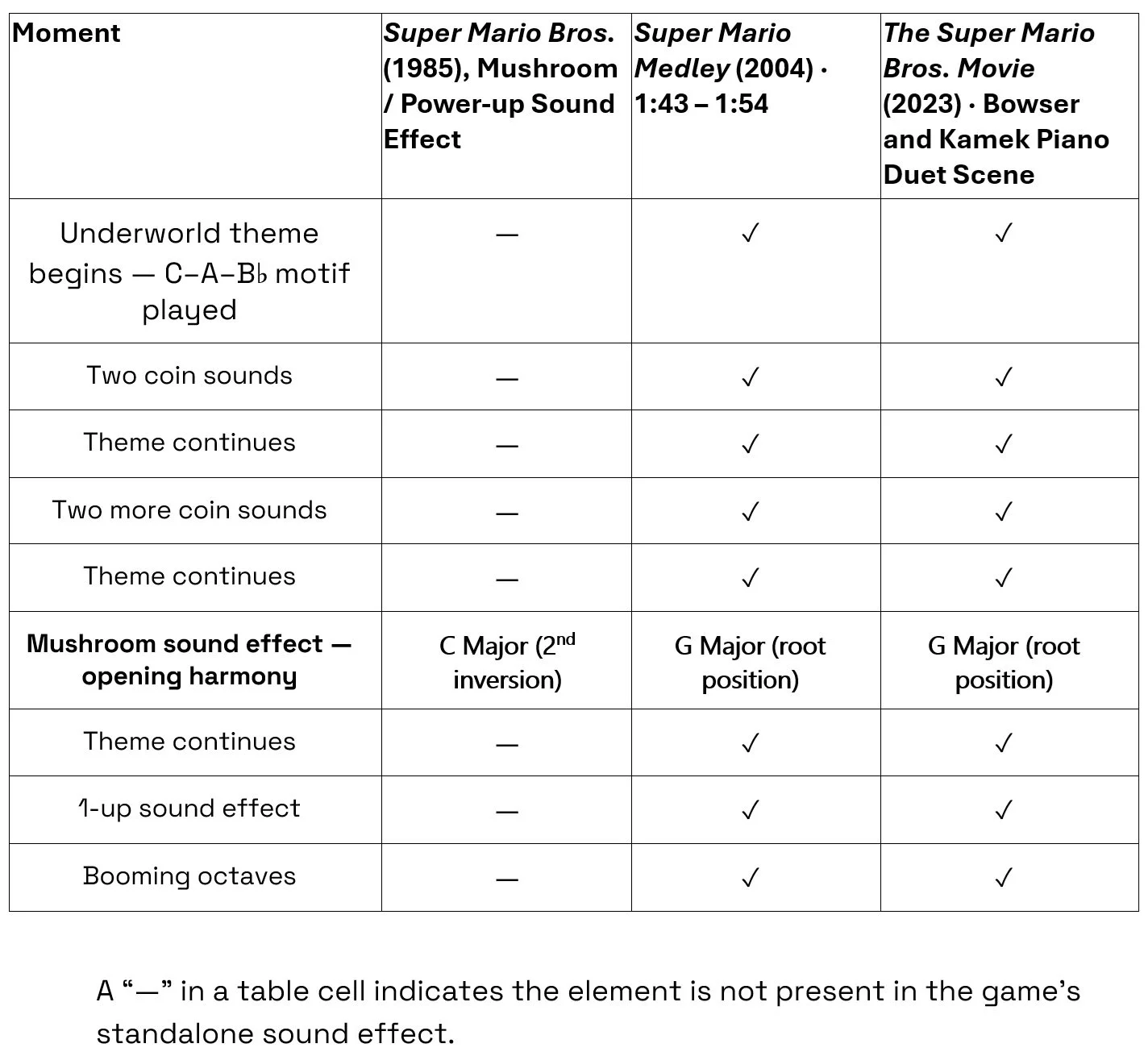
What the Super Mario Bros. (1985) Mushroom Sound Effect, Super Mario Medley (2004), and Super Mario Bros. Movie (2023) share
Please refer to the table below.
What Viewers Commented on the Super Mario Medley Video
“1:42 — they referenced this in the Super Mario Movie, even with the coin sounds. I automatically thought of this video." — @dre2culjackson367 · 230 likes
“1:44 — these exact details were also played during the Mario movie. Was that a reference to this video, or is that part of the official soundtrack?" — @s8v1 · 149 likes
“When King Koopa says ‘Jam with me.'" — @hyothehuman · 486 likes (pinned)
Comments can be viewed at: https://youtu.be/dFZki6TcY4w?t=103
